
Types of top Surgeries
Select Type of Surgery
- Double Incision (with FNG)
- Periareolar Incision
- Nerve-Preserving Double Incision
- Double Incision (without FNG)
- “Hockey-Stick” Double Incision (with FNG)
- Keyhole Incision
- Center-Joining Incision
- Fishmouth Incision
- Lollipop Incision
- Buttonhole Incision
- Inverted-T (Anchor) Incision
- No-Nipple Procedures
Double Incision, with FNG
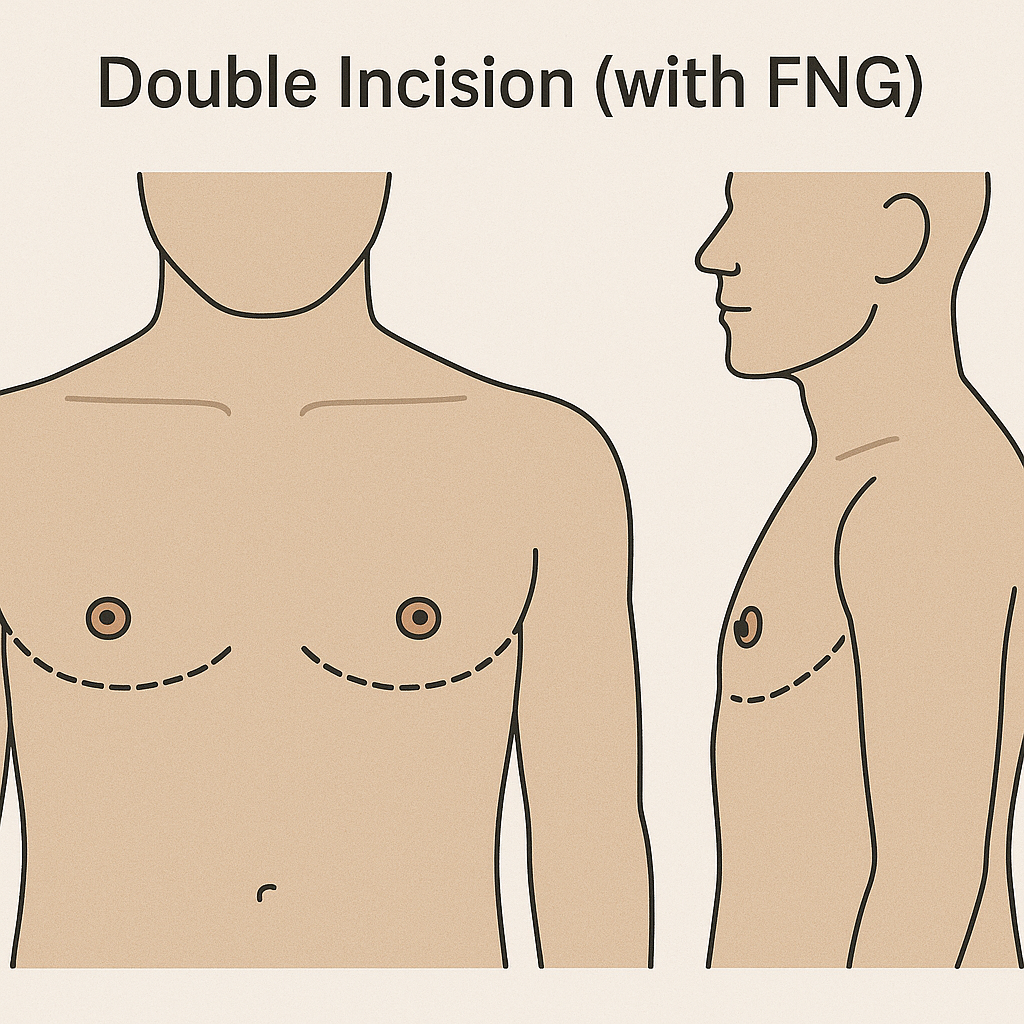
Also known as: ‘Bilateral Double Incision Mastectomy with FNG’
Best fit: individuals with larger chests and/or require excess skin removal
Procedure:
- Two bilateral incisions below the pectoral muscle, where excess skin and tissue can be excised
- Free nipple graft (FNG), where nipples and areola are removed, resized/reshaped, and grafted back onto the chest to their new location
- Placement of drains, if necessary
Post-operative:
- Pain management medication as needed
- Drains (if needed) stay in for approximately two weeks
- Minimum two to four weeks restricted lifting and movement
- Gradual increase in mobility
- Numbness and bruising are likely to occur
- Will require one or more post-operative visit(s) to redress wounds, remove drains, remove non-dissolvable sutures, and/or needle-drain excess fluid
Scarring:
- Bilateral scars heal in approximately two to four weeks
- Areola/nipple scars heal in approximately two to four weeks
- Scabbing will generally look worse than it is, scab can form over entire area and come off in pieces or one large scab
- Skin pigmentation may change
- Loss of nipple grafts are unlikely but may occur (see Complications and Concerns)
- Scars will go from deep red/pink to a lighter pink in two to six months with proper aftercare
- Scar care for healed incision (see Recovery and Scar Care)
Double Incision Overview:
Double incision with Free Nipple Grafts is a very popular top surgery procedure option and is well known for the large, bilateral scars visible along the lower pectoral line of the chest. While a popular option, this is one of the more invasive types of top surgery. It works well with individuals who want to achieve a flatter chest.
Free nipple grafts (FNG) allow for the surgeon to essentially “cut and paste” newly sized, and sometimes reshaped, areola and nipple to its new and final location. This does require removing the nipples from their blood supply, but losing a nipple is a highly unlikely outcome when performed by a skilled plastic surgeon.
This surgery is suited for individuals in most chest shapes and sizes. Patients with larger chests or with extra fat and skin are ideal candidates for double incision. This technique allows the plastic surgeon to perform a free nipple graft, make bilateral incisions, perform liposuction (if necessary), remove any extra skin and tissue, and position the nipples and areola more laterally.
The result is masculinizing the symmetry of the chest. Permanent removal of the nipple is an option (<a href="http://<h3 id="no-nipple-procedures"><strong>No-Nipple Procedures</strong>See No-Nipple Procedures), and they would simply not be removed or relocated back onto the chest after closing the bilateral incisions.
The bilateral scars are generally under the lower pectoral line and will slowly fade in thickness, color, and appearance over time. For FNG, the scarring will look your whole nipple is scabbing over until the scabbing around the wound sloughs off. Diligent post-operative care, as informed by your plastic surgeon, helps ensure the healing process goes smoothly and scar care is effective.
Periareolar Incision
Also known as: ‘Donut’ or ‘Peri’ or ‘Circumareolar’
Best Fit: individuals with smaller chest, nipples/areola, and require less excess skin removal
Procedure:
- Two circular, donut-like incisions around each areola
- One around the areola, diameter is approximately 22 mm
- Second is larger, allowing for skin excision
- A deeper, slit-like incision allows for the removal of chest tissue
- The donut is closed using a purse-string suture
- Placement of drains under incision, if necessary
Post-operative:
- Pain management medication as needed
- Minimum two to four weeks restricted lifting and movement
- Gradual increase in mobility
- Numbness and bruising are likely to occur
- Will require one or more post-operative visit(s) to redress wounds, remove non-dissolvable sutures, and/or needle-drain excess fluid
Scarring:
- Circular scars heal in approximately two to four weeks
- Scabbing will generally look worse than it is, scab can form over entire area and come off in pieces or one large scab
- Skin pigmentation may change
- Purse-string sutures can leave jagged/ripple pattern scar
- Scars will go from deep red/pink to a lighter pink in two to six months with proper aftercare
- Scar care for healed incision (see Recovery and Scar Care)
Periareolar Overview:
Periareolar incision is another popular top surgery option and is best known for the donut-like, circular incisions around the areola. Like the double incision technique, periareolar incision does allow for some shaping and minimal relocation. The benefit is that the blood supply to the nipple is kept intact, reducing the level of invasiveness and increasing sensation preservation.
This surgery is ideal for patients with some excess skin to remove and are looking for a surgery where the nipple blood supply will be minimally interrupted. Patients with larger chests are not likely good candidates for periareolar incision surgery because only a small portion of excess skin and tissue can be effectively removed.
The first incision is around the areola, giving it a smaller circumference and allowing for reshaping. The second incision is around a second, larger circle and the outermost epidermis skin is removed. Through a second deeper incision, the plastic surgeon creates an opening where the chest tissue will be removed, using liposuction if necessary. Once enough tissue is removed, the two circular incisions are sutured together.
This procedure can pose a challenge as the smaller and larger diameter circles do not angularly match up, causing the surgeon to use a purse string stitch suture. Though the two circles might not align perfectly, the healed result generally does not have noticeable nipple pattern that might be seen during the post-operative healing process.
The scars are hidden in the natural outline of the areola, making the healing process like less invasive than the bilateral incision technique.
Nerve-Preserving Double Incision
Also known as: ‘Sensation-Preserving Mastectomy’ or ‘Targeted Nipple Reinnervation (TNR)’
Best fit: individuals with larger chests and/or require excess skin removal, desire to keep sensation in the areola/nipple complex
Procedure:
- Two bilateral incisions below the pectoral muscle, where excess skin and tissue can be excised
- Nerve complex is preserved through dissection
- Free nipple graft, where nipples and areola are removed, resized/reshaped, and grafted back onto the chest to their new location, nerve complex rejoined to underside of nipple graft
- Diagonal incision from lateral incision to the areola/nipple incision
- Placement of drains, if necessary
Post-operative:
- Pain management medication as needed
- Drains (if needed) stay in for approximately two weeks
- Minimum two to four weeks restricted lifting and movement
- Gradual increase in mobility
- Numbness and bruising are likely to occur
- Will require one or more post-operative visit(s) to redress wounds, remove drains, remove non-dissolvable sutures, and/or needle-drain excess fluid
Scarring:
- Bilateral /diagonal scars heal in approximately two to four weeks
- Areola/nipple scars heal in approximately two to four weeks
- Scabbing will generally look worse than it is, scab can form over entire area and come off in pieces or one large scab
- Skin pigmentation may change
- Loss of nipple grafts are unlikely but may occur (see Complications and Concerns)
- Scars will go from deep red/pink to a lighter pink in two to six months with proper aftercare
- Scar care for healed incision (see Recovery and Scar Care)
Nerve-Preserving Double Incision Overview:
See above overview for Double Incision.
If you are concerned about maintaining sensation around your areola/nipple area, this alternative to the more common double incision top surgery could be of interest. It differs in the plastic surgeon’s technique of harvesting the nerves that innervate the nipple complex. In addition to free nipple graft, there will be an additional nerve graft that is returned to the nipple’s new placement.
This procedure requires a highly specialized provider that has experience in nerve grafting, which is not currently a common approach among gender-affirming surgical practitioners. The amount of preserved sensation is based on the level of sensation prior to surgery. Individuals with a higher BMI (>30) are likely to have reduced sensation after neurotization, in part from the mass of tissues being excised to flatten the chest contour.
Double Incision, without FNG
Also known as: ‘Bilateral Double Incision Mastectomy’ or ‘Nipple-Sparing Double Incision’
Best fit: individuals with smaller to medium-size chests, smaller areola/nipples
Procedure:
- Two bilateral incisions below the pectoral muscle, where excess skin and tissue can be excised
- Placement of drains, if necessary
Post-operative:
- Pain management medication as needed
- Drains (if needed) stay in for approximately two weeks
- Minimum two to four weeks restricted lifting and movement
- Gradual increase in mobility
- Numbness and bruising are likely to occur
- Will require one or more post-operative visit(s) to redress wounds, remove drains, remove non-dissolvable sutures, and/or needle-drain excess fluid
Scarring:
- Bilateral scars heal in approximately two to four weeks
- Scars will go from deep red/pink to a lighter pink in two to six months with proper aftercare
- Scar care for healed incision (see Recovery and Scar Care)
Double Incision, without FNG Overview:
See above overview for Double Incision, with Free Nipple Graft (FNG)
Double incisions without free nipple grafts allows for the plastic surgeon to remove tissues through the lateral incisions while keeping the nipple complex intact, preserving nipple sensation. This top surgery method is best suited for individuals who are pleased with their areola/nipple size and location, as the procedure does not allow for resizing and only minimal relocation.
‘Hockey-Stick’ Double Incision with FNG
Also known as: ‘Hockey-Stick Incision’
Best fit: individuals who wish to maintain a muscular chest post-op and want to blend scars into natural pectoral line laterally
Procedure:
- Two bilateral incisions below the pectoral muscle, where excess skin and tissue can be excised
- Medial (towards middle) scars curve under pectoral line, laterally incision is angled up towards armpit
- Free nipple graft (FNG), where nipples and areola are removed, resized/reshaped, and grafted back onto the chest to their new location
- Placement of drains, if necessary
Post-operative:
- Pain management medication as needed
- Drains (if needed) stay in for approximately two weeks
- Minimum two to four weeks restricted lifting and movement
- Gradual increase in mobility
- Numbness and bruising are likely to occur
- Will require one or more post-operative visit(s) to redress wounds, remove drains, remove non-dissolvable sutures, and/or needle-drain excess fluid
Scarring:
- Bilateral scars heal in approximately two to four weeks
- Scars will go from deep red/pink to a lighter pink in two to six months with proper aftercare
- Scar care for healed incision (see Recovery and Scar Care)
Double Incision, without FNG Overview:
See above overview for Double Incision, with Free Nipple Grafts (FNG)
Hockey-stick double incisions are ideal if you are looking to blend the double incisions under a defined pectoral muscle.
Keyhole Incision
Also known as: ‘Keyhole’ or ‘Semi-Circular Areola Incision’
Best Fit: individuals with small chest, nipples/areola, and require no excess skin removal
Procedure:
- Two, semi-circular incisions under each areola
- Half-moon shaped
- A deeper, slit-like incision allows for the removal of chest tissue
- Liposuction, if needed, to remove excess tissue
- Placement of drains, if necessary
Post-operative:
- Pain management medication as needed
- Minimum two to four weeks restricted lifting and movement
- Gradual increase in mobility
- Numbness and bruising are likely to occur
- Will require one or more post-operative visit(s) to redress wounds, remove non-dissolvable sutures, and/or needle-drain excess fluid
Scarring:
- Semi-circular scars heal in approximately two to four weeks
- Scabbing will generally look worse than it is, scab can form over entire area and come off in pieces or one large scab
- Skin pigmentation may change
- Scars will go from deep red/pink to a lighter pink in two to six months with proper aftercare
- Scar care for healed incision (see Recovery and Scar Care)
Keyhole Overview:
Keyhole is top surgery option suited for only about 5% of top surgery candidates. It requires the candidate to have a low BMI, small chest, and small areola/nipples and requires no tissue removal. The benefit of keyhole is minimal scarring, a minimally invasive scarring, and faster recovery period.
Since nerves connection to the areola/nipples is never disrupted, there is a higher chance of preserving chest sensation. The minimal scarring can improve an individual’s satisfaction post-operative satisfaction.
Center-Joining Incision
Also known as: ‘Joining Incision’ or ‘Single Lateral Incision’
Best Fit: individuals with larger chest, requiring extensive skin removal
Procedure:
- Two, lateral incisions, joining in the center of the chest
- A deeper, slit-like incision allows for the removal of chest tissue
- Free nipple graft (FNG), where nipples and areola are removed, resized/reshaped, and grafted back onto the chest to their new location
- Liposuction, if needed, to remove excess tissue
- Placement of drains, if necessary
Post-operative:
- Pain management medication as needed
- Drains (if needed) stay in for approximately two weeks
- Minimum two to four weeks restricted lifting and movement
- Gradual increase in mobility
- Numbness and bruising are likely to occur
- Will require one or more post-operative visit(s) to redress wounds, remove drains, remove non-dissolvable sutures, and/or needle-drain excess fluid
Scarring:
- Joining lateral scar heal in approximately two to four weeks
- Areola/nipple scars heal in approximately two to four weeks
- Scabbing will generally look worse than it is, scab can form over entire area and come off in pieces or one large scab
- Skin pigmentation may change
- Loss of nipple grafts are unlikely but may occur (see Complications and Concerns)
- Scars will go from deep red/pink to a lighter pink in two to six months with proper aftercare
- Scar care for healed incision (see Recovery and Scar Care)
Center-Joining Incision Overview:
This procedure can provide the patient with the maximal amount of excess tissue excision. The joining of the scars at the center might not be ideal for the patients who are concerned with hiding scars, but with scar care, can be minimized with time.
Fishmouth Incision
Best Fit: individuals who desire a non-traditional scar
Procedure:
- Two lateral incisions, across the center of the chest, circling around the areola/nipple complex (NAC)
- Non-traditional scars located along the lateral plane of the nipples, not under pectoral muscles
- Placement of drains, if necessary
Post-operative:
- Pain management medication as needed
- Drains (if needed) stay in for approximately two weeks
- Minimum two to four weeks restricted lifting and movement
- Gradual increase in mobility
- Numbness and bruising are likely to occur
- Will require one or more post-operative visit(s) to redress wounds, remove drains, remove non-dissolvable sutures, and/or needle-drain excess fluid
Scarring:
- Fishmouth scars heal in approximately two to four weeks
- Scabbing will generally look worse than it is, scab can form over entire area and come off in pieces or one large scab
- Skin pigmentation may change
- Scars will go from deep red/pink to a lighter pink in two to six months with proper aftercare
- Scar care for healed incision (see Recovery and Scar Care)
Fishmouth Overview:
This procedure results in a unique scar pattern and equally unique scar healing process. The incisions circling the nipple/areola complex (NAC) allows for resizing without complete removal, allowing for sensation preservation. The scar placement is not easily hidden, although their appearance will flatten and diminish with time. Fishmouth top surgery can be desirable for individuals who are interested in a unique scar pattern.
Lollipop Incision
Also known as: ‘Short-Scar with Periareolar’ or ‘Vertical-Scar with Periareolar’
Best Fit: individuals with smaller chests, require minimal skin removal
Procedure:
- Two, vertical incisions with periareolar incisions
- A deeper, slit-like incision allows for the removal of chest tissue
- Liposuction, if needed, to remove excess tissue
- Placement of drains, if needed
Post-operative:
- Pain management medication as needed
- Drains (if needed) stay in for approximately two weeks
- Minimum two to four weeks restricted lifting and movement
- Gradual increase in mobility
- Numbness and bruising are likely to occur
- Will require one or more post-operative visit(s) to redress wounds, remove drains, remove non-dissolvable sutures, and/or needle-drain excess fluid
Scarring:
- Vertical/areola/nipple scars heal in approximately two to four weeks
- Scabbing will generally look worse than it is, scab can form over entire area and come off in pieces or one large scab
- Skin pigmentation may change
- Scars will go from deep red/pink to a lighter pink in two to six months with proper aftercare
- Scar care for healed incision (see Recovery and Scar Care)
Lollipop Incision Overview:
This procedure is similar to periareolar incisions, with the addition of two short, vertical incisions extending down from the nipple/areola complex (NAC). This is ideal for periareolar candidates with a small amount of skin that needs to be removed to flatten the chest contour. Like traditional periareolar incisions, there is no ability to reposition the NAC.
Buttonhole Incision
Also known as: ‘Buttonhole with Double Incision’ or ‘Nipple-Sparing Double Incision’
Best Fit: individuals with larger chests, wanting to preserve nipple/areola sensation
Procedure:
- Two, bilateral incisions with no Free Nipple Graft (FNG)
- A deeper, slit-like incision allows for the removal of chest tissue
- Liposuction, if needed, to remove excess tissue
- Placement of drains, if needed
Post-operative:
- Pain management medication as needed
- Drains (if needed) stay in for approximately two weeks
- Minimum two to four weeks restricted lifting and movement
- Gradual increase in mobility
- Numbness and bruising are likely to occur
- Will require one or more post-operative visit(s) to redress wounds, remove drains, remove non-dissolvable sutures, and/or needle-drain excess fluid
Scarring:
- Bilateral scars heal in approximately two to four weeks
- Scabbing will generally look worse than it is, scab can form over entire area and come off in pieces or one large scab
- Skin pigmentation may change
- Scars will go from deep red/pink to a lighter pink in two to six months with proper aftercare
- Scar care for healed incision (see Recovery and Scar Care)
Buttonhole Incision Overview:
This procedure is like Inverted-T (Anchor) Incision, where the blood supply to the nipple/areola complex (NAC) is preserved. Buttonhole incision top surgery still has variable sensation preservation results. Because a peduncle of skin is used to maintain the blood supply during surgery, the result is often a visible area of remaining tissue that results in a visible area of chest tissue. This is generally not a desired masculinization outcome and will likely hide toned chest muscles from looking as defined as the results seen in Double Incision top surgeries. Further revision and surgeries might be required to remove excess fullness after Buttonhole Incision surgery for the appearance of a flat chest.
Inverted-T (Anchor) Incision
Also known as: ‘Inverted-T’ or ‘T-Anchor’
Best Fit: individuals with larger chests, wanting to preserve nipple/areola sensation
Procedure:
- Two, bilateral incisions joining with two vertical incisions with no Free Nipple Graft (FNG)
- A deeper, slit-like incision allows for the removal of chest tissue
- Liposuction, if needed, to remove excess tissue
- Placement of drains under incision, if needed
Post-operative:
- Pain management medication as needed
- Drains (if needed) stay in for approximately two weeks
- Minimum two to four weeks restricted lifting and movement
- Gradual increase in mobility
- Numbness and bruising are likely to occur
- Will require one or more post-operative visit(s) to redress wounds, remove drains, remove non-dissolvable sutures, and/or needle-drain excess fluid
Scarring:
- Bilateral scars heal in approximately two to four weeks
- Scabbing will generally look worse than it is, scab can form over entire area and come off in pieces or one large scab
- Skin pigmentation may change
- Scars will go from deep red/pink to a lighter pink in two to six months with proper aftercare
- Scar care for healed incision (see Recovery and Scar Care)
Inverted-T Incision Overview:
This top surgery option is best suited for individuals with a larger BMI, inelastic skin, and/or do not have an interest in a completely flat chest. Individuals with a larger BMI might want their new chest to match their body-type and want to avoid an indented-appearing chest that might come with the Double Incision method. The nipple/areola complex (NAC) can be moderately resized, while a peduncle is kept intact to aid in the preservation of the blood supply and nervous surrounding the area. For those who are not looking to have residual volume or fullness in their chest should avoid Inverted-T top surgery.
No-Nipple Procedures
Nipple-free or blank slate top surgeries involve the removal of the nipple/areola complex (NAC). This technique can be chosen based on the desired aesthetic outcome and is becoming popular in the trans/nonbinary community. Often, this reduces the surgical complexity, healing time, and avoids potential free nipple graft (FNG) complications or graft loss. The most common no-nipple procedures are bilateral double incision, keyhole, and periareolar surgery techniques without free nipple grafts. Generally, a no-nipple procedure is chosen based on a personal aesthetic preference opposed to medical necessity. Some individuals may opt to get nipple tattoos once post-op healing is complete.
Next page: finding a surgeon
 I Want Top Surgery